


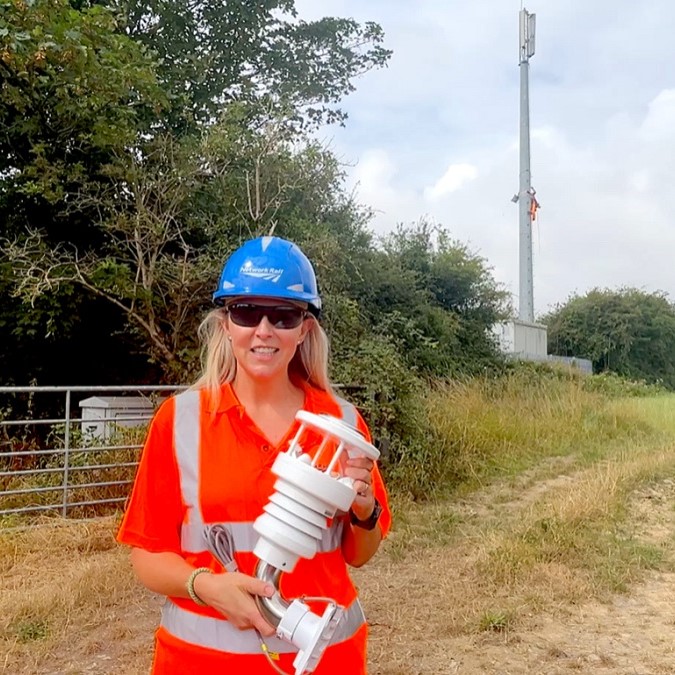
Network Rail has become the first in Britain to install weather monitoring stations on existing railway communication masts, as part of efforts to improve resilience against increasingly disruptive weather conditions.
Ten new monitoring stations have been installed across the Wales and Borders route, providing real-time information on rainfall, wind speed, temperature and other atmospheric conditions directly from the railway.
Developed by Ninehundred Communications Group, the technology uses existing GSM-R communication masts to collect localised weather data, helping operational teams make more informed decisions about infrastructure inspections, speed restrictions and responses to severe weather.
The investment follows a period of significant weather-related disruption across the region, with 25 named storms affecting the Wales and Borders railway between February 2023 and January 2026.
Network Rail hopes the improved monitoring capability will help reduce unnecessary disruption while maintaining safety during increasingly challenging weather conditions.
Storm disruption highlights need for better weather intelligence
Severe weather has become a major operational and financial challenge for Britain’s railway, with high winds, intense rainfall and flooding affecting infrastructure reliability and train performance.
On the Wales and Borders route, Network Rail recorded 25 named storms over the three-year period to January 2026.
Where complete performance information is available, each storm resulted in an average of more than 38 hours of train delays and £179,000 in performance-related costs.
Storm Darragh, which struck Wales on 6 and 7 December 2024, was particularly damaging.
Wind speeds reached 93mph at Capel Curig, with fallen trees and debris causing widespread disruption to railway services.
Network Rail estimates the storm resulted in £1.3 million in train performance costs, making it the most expensive weather event recorded during the period.
These figures illustrate the scale of the challenge facing infrastructure managers, particularly across routes exposed to strong winds, flooding and difficult terrain.
The financial impact also extends beyond direct infrastructure damage, with disruption affecting passenger journeys, freight movements and railway operations.
Using existing railway infrastructure to monitor conditions
The new monitoring equipment has been installed on GSM-R masts at ten locations across Wales and the Borders.
In south and mid Wales, stations have been installed at Whitland, Llantwit, Cilmeri, St George’s and Trewyn.
Further installations are located at Craven Arms, Gobowen, Glantwymyn, Llanrwst and Buckley.
The locations were selected to address gaps in existing weather monitoring coverage, particularly in areas vulnerable to severe conditions.
Each station measures rainfall, wind speed and direction, temperature, humidity and atmospheric pressure.
By collecting information directly from railway locations, Network Rail can obtain a more accurate picture of the conditions affecting individual sections of the network.
Using existing GSM-R masts also provides the height required for effective weather observations without the expense and complexity of constructing separate monitoring structures.
The approach demonstrates how established railway assets can be adapted to support additional monitoring technologies, potentially offering a cost-effective model for wider deployment.
Better data could mean fewer unnecessary restrictions
Network Rail already works with specialist forecasting provider MetDesk to monitor weather conditions and prepare for potentially disruptive events.
The new stations will complement this forecasting capability by providing real-time observations from locations on the railway itself.
This distinction is important because weather conditions can vary significantly over relatively short distances, particularly in mountainous or exposed areas.
A regional forecast may indicate high winds or heavy rainfall, but local monitoring can help establish whether those conditions are actually being experienced at a particular railway location.
The information could allow operational teams to take more targeted action, including deploying inspection teams, monitoring vulnerable infrastructure and introducing speed restrictions where necessary.
Equally, more accurate local data could help avoid imposing restrictions over unnecessarily large areas when severe conditions are confined to specific locations.
The stations will also provide information to help MetDesk refine its forecasts and support Network Rail in reviewing the weather thresholds used to guide operational decisions.
For railway operators, this could improve the balance between maintaining safety and minimising avoidable disruption.
Network Rail targets more proactive weather management
Daniel Booth, Head of Operational Weather Strategy at Network Rail Wales and Borders, said: “Autumn is always one of the most challenging periods of the year for the railway, and a huge amount of preparation goes into reducing the impact on passengers and freight customers.
“On the Wales and Borders route, we’re always looking at how new technology can help us better understand and respond to the challenges our railway faces. These new weather stations are a great example of that, giving our teams access to more accurate, localised information about conditions on the ground.
“By learning from events like Storm Darragh and working closely with our weather forecasting partners, we can make better-informed decisions, respond earlier to changing conditions and ultimately help keep the railway running safely and reliably.”
The project reflects a broader shift towards more proactive weather management, using improved data to identify risks before they develop into major operational incidents.
As weather patterns become more challenging, the ability to understand conditions at individual railway locations is increasingly important for infrastructure maintenance and operational planning.
Wider autumn resilience programme underway
The weather monitoring investment forms part of Network Rail’s wider autumn preparedness programme across Wales and Borders.
Four specialist treatment trains are scheduled to cover more than 54,400 miles of track, helping reduce the impact of fallen leaves and low rail adhesion on train performance.
Network Rail has also undertaken targeted drainage improvements at locations vulnerable to flooding and increased vegetation management to reduce the risk of trees and branches falling onto the railway.
Ten dedicated Autumn Response Teams are available to respond to changing conditions and emerging infrastructure issues.
These measures are intended to address some of the most common seasonal causes of railway disruption, including flooding, vegetation-related incidents and poor railhead conditions.
The additional weather stations will provide another source of information to support decisions about where resources should be deployed.
Potential model for wider railway deployment
Although the initial installation covers ten locations in Wales and Borders, the approach could have wider relevance across Britain’s railway.
GSM-R infrastructure is already distributed throughout much of the national network, creating potential opportunities to use existing assets for additional environmental monitoring.
The use of established communication masts could reduce installation costs while providing observations from locations directly relevant to railway operations.
For infrastructure managers, the benefits of this type of technology will depend on how effectively monitoring data can be integrated into forecasting systems, operational procedures and maintenance planning.
The project also highlights the growing role of digital monitoring and predictive intelligence in managing railway resilience.
With severe weather placing increasing pressure on infrastructure performance and maintenance budgets, more accurate local information could help railway organisations respond earlier and direct resources more efficiently.
The Wales and Borders deployment represents an initial application of that approach, combining existing communications infrastructure with new monitoring technology to improve understanding of weather-related risks.
As the stations begin generating operational data, Network Rail will be able to assess how effectively the additional information supports decision-making and whether similar installations could benefit other parts of the network.


