


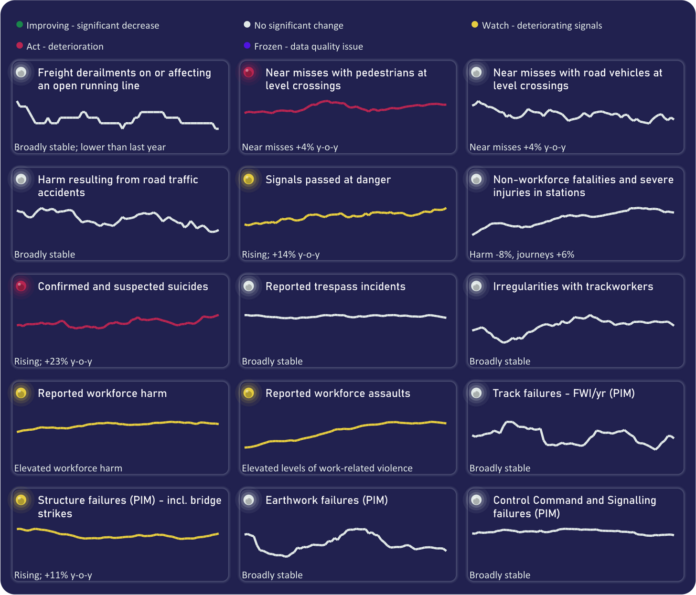
The Rail Safety and Standards Board (RSSB) has identified several areas of growing safety concern across Britain’s railway, including a decade-high number of level crossing fatalities, rising suspected suicides, increased workforce assaults and a deterioration in signals passed at danger (SPAD) performance.
RSSB’s latest Periodic Safety Performance Report, covering 20 September to 17 October 2026, highlights the need for targeted intervention as passenger numbers and train movements continue to increase.
Despite these concerns, underlying risk from serious train accidents has fallen by 7% compared with the previous year, while fatalities excluding suicides decreased from 35 to 31.
Annual passenger journeys reached 1.9 billion, up 6%, while train kilometres increased by 4%, increasing overall exposure to operational safety risks.
Level crossing fatalities reach decade high
Twelve people lost their lives at level crossings over the rolling year, the highest number recorded in a decade.
Combined with an increasing trend in near misses, RSSB says the figures indicate growing risk, driven primarily by unsafe user behaviour and distraction.
A senior-level Level Crossing Task Force is targeting improvements in sighting, asset condition, signage and public behaviour, alongside reviewing the reliance on whistle boards as the primary mitigation at passive crossings.
Research is also underway to establish whether children and young people face increased risks at level crossings.
Meanwhile, the number of suicides and suspected suicides recorded across the railway increased from 255 to 314 over the rolling year, prompting RSSB to escalate its assessment of the issue.
Infrastructure managers and operators are encouraged to review prevention arrangements, staff training and the effectiveness of interventions ahead of winter.
SPADs increase by 14% as overspeeding remains a concern
The report recorded 331 signals passed at danger over the rolling year, representing a 14% increase compared with the previous year.
Analysis identified recurring human and operational factors, including distraction, expectation bias, route familiarity and weaknesses in operational controls.
Empty coaching stock movements continue to account for a disproportionate number of incidents relative to train kilometres operated.
RSSB is encouraging operators to look beyond individual incidents when conducting investigations, examining underlying organisational and operational conditions that contribute to recurring safety events.
Overspeeding also remains a significant concern because of its potential to contribute to derailments, collisions and SPADs.
Network Rail and train operators are continuing to collaborate through Junction Overspeed Risk Assessment Tool workshops, identifying higher-risk junctions and strengthening engineering and operational controls.
Workforce assaults continue to increase
Reported workforce assaults have increased by 22% over the past three years, with 11,289 incidents recorded during 2025/26, up 12% on the previous year.
Verbal abuse accounted for 57% of incidents, physical assaults for 22% and threats for the remaining 21%.
A multi-agency strategy is being developed to address work-related violence, alongside the introduction of Railway Behavioural Notices targeting serious and persistent offenders.
RSSB also encourages employers to review the use of body-worn cameras where appropriate.
Winter weather presents additional infrastructure risks
The report highlights concerns around earthwork vulnerability following prolonged dry conditions and forecasts of wetter and stormier weather.
Although the long-term trend in earthwork failures remains broadly stable, RSSB is urging infrastructure managers to remain vigilant during the peak season for rainfall-related failures.
Its PRIMA-Rain risk modelling tool has already been deployed across several Network Rail regions, while PRIMA-Wind, designed to assess treefall risks during extreme weather, is entering trials.
Maintaining safety performance through railway reform
Despite the emerging concerns, station safety performance remains broadly stable, while workforce sickness absence has fallen from 5.09% to 4.59% year on year.
The findings present a mixed picture for Britain’s railway as it undergoes significant structural reform.
While reductions in underlying train accident risk demonstrate progress, deteriorating performance across several individual risk areas reinforces the importance of maintaining effective safety controls, investing in workforce competence and ensuring that organisational change does not distract from established operational safety priorities.


