


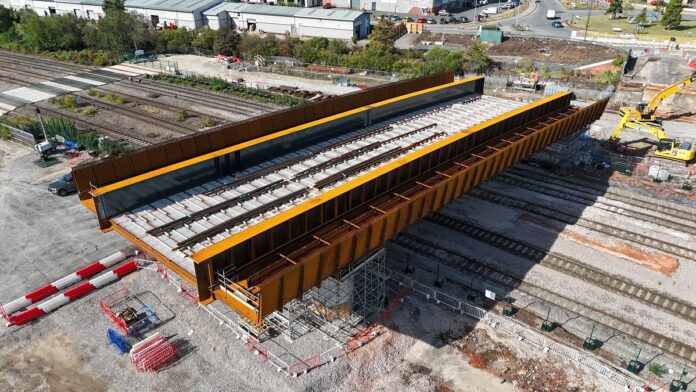
HS2 has completed the first major installation for the replacement Saltley Viaduct in Birmingham, moving a 55-metre steel bridge section into position over the existing Birmingham to Derby railway during the August Bank Holiday.
The operation marks the completion of the first of four phases in a complex programme to replace the former B4114 structure with a taller and wider viaduct capable of carrying the road over both the existing railway and the future HS2 line.
Balfour Beatty VINCI (BBV), HS2’s construction partner in the West Midlands, assembled the first steel span on land alongside the railway before moving it approximately 125 metres into its final position using self-propelled modular transporters (SPMTs).
The installation was coordinated with Network Rail and carried out during a temporary closure of the Birmingham to Derby railway, allowing passenger services to resume as planned on 1 September.
New bridge required to accommodate HS2
The original Saltley Viaduct crossed a 183-metre section of the B4114 and was closed to motorists and pedestrians in May 2026.
It was subsequently demolished to make way for a taller replacement structure that will provide the clearance required for high-speed trains to pass beneath it.
Its location makes the reconstruction particularly challenging. The completed structure and associated road realignment must negotiate the existing Birmingham to Derby railway, the future HS2 railway, the Birmingham and Warwick Junction Canal and the River Rea.
That complexity has resulted in the installation being divided into four main phases rather than attempting to construct the entire crossing in a single operation.
Nic Ryder, HS2 Ltd’s Project Manager for the works, said: “Our engineering team is making fantastic progress and everyone worked incredibly hard over the Bank Holiday weekend to ensure we were finished in time for the railway to reopen.
“In the three months since the road closed, they have demolished the original structure and successfully installed the first span of the replacement bridge, putting us on track to proceed to the next phase.”
SPMTs minimise disruption to existing railway
Using SPMTs allowed BBV to construct the 55-metre span away from the operational railway before transporting the completed section into position during a planned possession.
The technique reduces the amount of construction activity that needs to take place directly above the railway and allows a substantial bridge section to be installed within a relatively short closure.
It is an approach BBV has used elsewhere on HS2’s Birmingham works.
Dan Binns, Senior Project Manager for Balfour Beatty VINCI, said: “The new Saltley Viaduct is the latest HS2 structure to emerge in this area of Birmingham, after BBV engineers safely manoeuvred the first 55-metre span over an existing rail line.
“We chose the same technique used on the neighbouring Aston Church Road bridge two years ago, where the span was assembled next to the railway, before being driven into place on wheels to minimise the impact on rail passengers as much as possible.”
For HS2, such interfaces with the operational railway are among the more demanding parts of construction, requiring work to be planned around possessions while ensuring existing passenger and freight services can resume on schedule.
Second span to cross future HS2 railway
With the first phase complete, BBV is now assembling a second steel span measuring 35 metres.
Unlike the first section, this will eventually cross the new HS2 railway itself and is scheduled to be lifted into position by crane in October.
The third and fourth spans, which will cross the Birmingham and Warwick Junction Canal, are due to follow later this year.
Engineers will then complete the connections between the railway perimeter and the bridge abutments. A separate new bridge over the River Rea will also be constructed as part of the overall realignment of the B4114.
Together, the works illustrate the scale of enabling infrastructure required to thread HS2 through an already heavily developed part of Birmingham, where the new railway must interact with existing roads, conventional railways, waterways and other infrastructure.
Wider replacement will improve walking and cycling provision
The new Saltley Viaduct is expected to reopen to motorists and pedestrians in November 2027.
While its replacement is principally required to accommodate HS2, the finished structure will also be four-and-a-half metres wider than its predecessor.
The additional width will provide more space for cyclists and pedestrians, with wider walkways incorporating LED lighting within the panels.
HS2 and BBV have worked with Birmingham City Council, Transport for the West Midlands and National Express on diversion routes and bus arrangements while the B4114 crossing is unavailable.
Separately, HS2 has awarded Birmingham City Council more than £2.5m for road safety improvement initiatives along the route of the new railway, with the funding required to be spent by the end of December 2026.
The successful Bank Holiday installation completes only the first part of the Saltley programme, but it removes one of its most sensitive interfaces with the existing railway. Attention will now shift to the October lift over the future HS2 alignment and the remaining canal crossings as the replacement viaduct takes shape ahead of its planned 2027 opening.


