


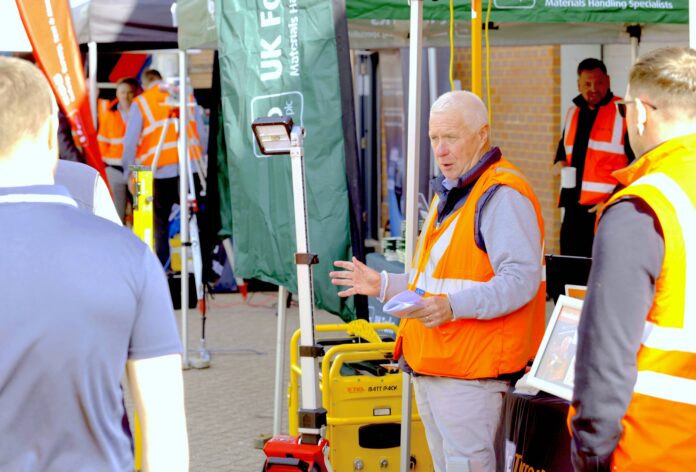
Vp Rail sits within Vp Plc, working as the conduit for growing Vp’s presence across the rail sector. Director, Carl Abraitis – with 40 years of experience in the sector – talks through some of his most interesting projects of the last 12 months and explains how Vp’s different business areas complement each other and delivery for the client.
How does the central hire desk work in practice on a live site?
The model scales to the complexity of the job. Where a project sits predominantly with Torrent Trackside and draws light support from the other businesses, it runs through the dedicated Torrent Trackside hire desk. Where a project is more complex and shared across divisions, Vp’s central function leads, appointing a key account manager who is accountable for compliance and service quality. That role goes beyond hire administration: the account manager attends site, checks that plant and people are performing, and sits in on weekly reviews and planning meetings, working as an extension of the customer’s own team rather than an external supplier. We are a bolt-on to the customer’s organisation and part of the team.
Two examples reflect Vp’s range, flexibility and customer service. On Sizewell C, Vp has hire controllers based at the customer’s centre of excellence as well as a key account manager on site, reflecting how critical direct interaction is at a remote location. On Network Rail work generally, the operation runs from Torrent Trackside, where a dedicated team of hire controllers manage communication across more than 250 Network Rail locations at any one time, spanning Torrent Trackside, Brandon Hire Station, ESS, TPA and Groundforce.
What proportion of Vp Rail projects now involve more than one division? How do you anticipate it moving in future?
In practice, almost all rail projects draw on more than one Vp business, even straightforward ones. A simple example: installing 200 metres of trackway and a road-rail access point through a farmer’s field for temporary site access. That single scope already involves four businesses: TPA for trackway and access, ESS for survey and ground investigation equipment, Brandon Hire Station for temporary lighting, and Torrent Trackside for PTS-qualified operatives and site labour. Without a central point of contact, the customer would need to manage four separate sets of orders, delivery instructions and invoices; the central function removes that burden. As our technology continues to evolve and innovate, this function will continue to grow, making the process even smoother for our customers and their complex projects.
Safety, accreditation and delivery evidence
The rail industry is heavily regulated as are many of the sectors we operate within.
Within Vp we pride ourselves on having very experienced leadership team that is supported by in-house safety and assurance professionals.
Vp Rail businesses operate under RISQS, the Rail Industry Supplier Qualification Scheme, for any activity on Network Rail infrastructure, holding several levels of qualification that are audited regularly and overseen by compliance managers working across the Group. Outside the Network Rail estate, Vp holds accreditations to work on London Underground infrastructure and on light rail and metro systems elsewhere in the UK. Engineers and fitters are assessed individually and may only work on equipment they are specifically trained and signed off for, and the team runs regular site safety tours with customers to review equipment and working practices.
On delivery performance, our Network Rail contract, for example, demands a high level of equipment maintained in service. For the duration of the contract period, we have always exceeded the target.
What is Vp’s competitive position?
Vp holds a strong position in integrated rail packages, underpinned by agreements with most UK track renewal contractors and by its role as principal provider of portable plant and services to Network Rail. On the largest programmes, work is typically shared with peers because the scope is broad and delivered in stages; Vp’s advantage there is the breadth of capability it can bring as a single group.
Vp wins by combining specialist capability, service quality and a broad, integrated Group offer. For example, on HS2, Groundforce and TPA have supported major infrastructure and earthworks activity with shoring, piling, embankment stabilisation and access solutions. Groundforce continues to win work through the quality of its plant, in-house design capability and service delivery, while for TPA other UK suppliers cannot offer the same rapid rail access capability.
We have been supplying plant and services on Great Western and Anglia Regions supporting ongoing projects. This emphasises Vp’s breadth of service offering, as well as the strength and expertise of the site teams at locations where work takes place.
I truly believe Vp is best placed to provide the full integrated package across plant, access, survey, communications, safety equipment and specialist rail support
What does the CP7 pipeline look like from where you sit?
We are now in year three of the CP7 cycle and continue to respond as major schemes reach the market. Network Rail has visibility of planned spend through to the end of the control period in March 2029, while the full track construction phase of HS2 has budgets in excess of £4bn.
We remain optimistic about the wider rail pipeline for this year and beyond with significant opportunities across a wide range of planned projects across the UK, including the drive to improve ageing railway infrastructure which is expected to continue via significant investment in FP1 under Great British Railways. Outside of CP7, growth has been significant on light rail systems and private infrastructure works (such as Sizewell) and this continues at pace. We are also actively reviewing opportunities across Ireland.
What has changed the most during your 40 years of experience andwhat makes this period particularly exciting?
The industry has become a safer, more inclusive place to work in for sure – which is a testament to the people involved today. Many of the practices have changed over the four decades I have worked here, but it is still the ‘permanent way’ as it is known.
The new period of modernising the railway is particularly exciting as we develop our product offering to support digitisation and technology with the likes of remote monitoring of the infrastructure, removing the people /plant interface to make the railways a safer environment for the engineers working on it and the customers using it.


